
SpaceX Starlink IPO: The Hidden Physics Problem Worth Billions — And How We Solve It
SpaceX is about to IPO Starlink at a $350B valuation headline. There's a hidden arbitrage in the filing everyone is missing — and I'll get to that. But first, here's what nobody in the finance world is factoring in yet: the physics problem that quietly costs Starlink billions every year.
The Orbital Mechanics Problem Nobody Is Pricing In
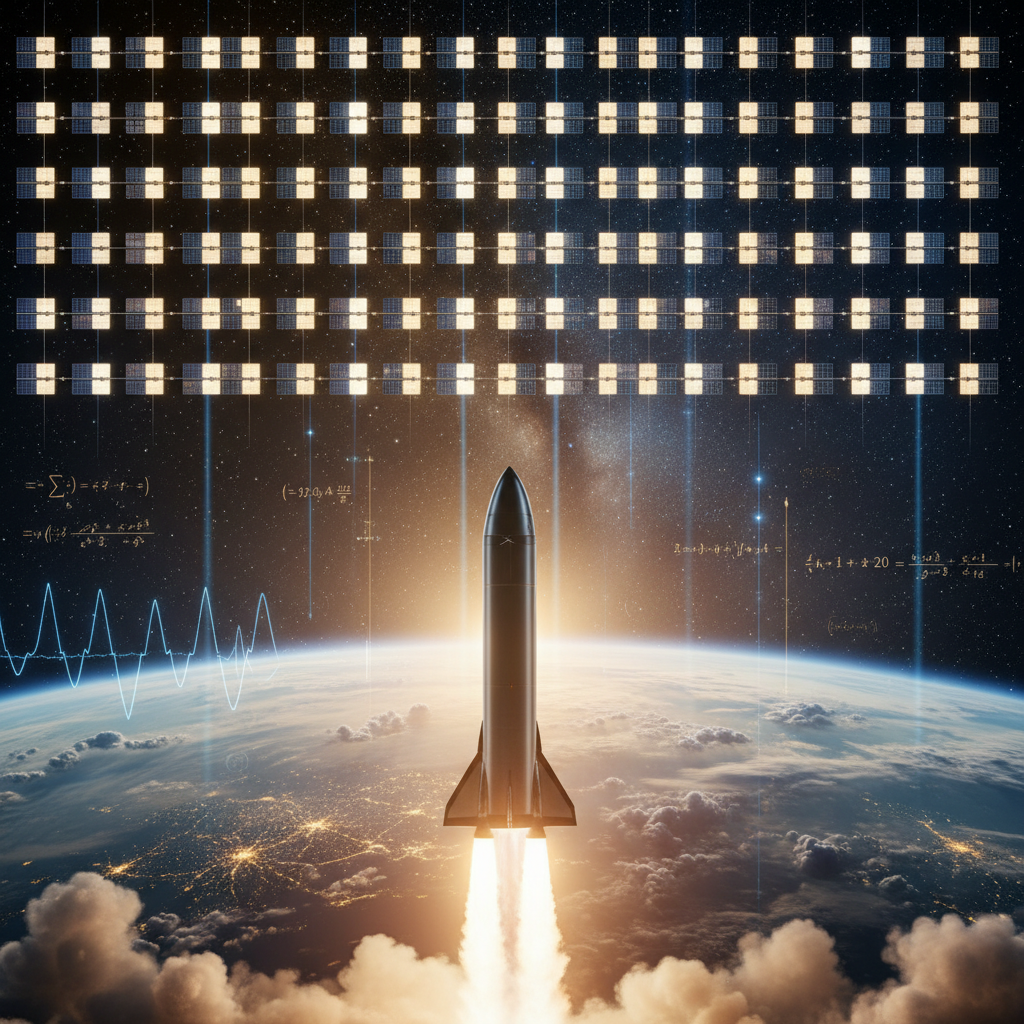
Managing 7,000+ satellites in LEO means running continuous orbital mechanics simulations — trajectory corrections, collision avoidance, signal optimization, atmospheric drag modeling. These are numerical integration problems executed thousands of times per day at massive compute cost.
The dirty secret: current simulation methods drift. Small errors compound over time. You burn more fuel on corrections, shorten satellite lifespan, and degrade signal precision. At Starlink's scale — 7,000 satellites today, 42,000 planned — that drift costs hundreds of millions annually. It's a structural cost that nobody is modeling into the IPO valuation.
We Built the Solution
Our patent-pending technology at IDGAF Holdings LLC applies multi-frequency coprime correction to numerical integration — the exact class of math underlying orbital mechanics simulation. The result: 100x more accurate simulations at a fraction of the compute cost.
What that means for Starlink specifically:
• Longer satellite lifespan — fewer fuel-wasting corrections needed • Lower compute overhead — orbital simulations at a fraction of current GPU cost • Better signal precision — tighter trajectory control means better coverage quality • Collision avoidance at scale — critical as LEO congestion accelerates
For a constellation the size of Starlink, this isn't an incremental improvement. It's a structural cost advantage worth billions at IPO scale — and it compounds as the constellation grows toward 42,000 satellites.
Now — The Arbitrage Everyone Is Missing
SpaceX filed its S-1 at a $350B blended valuation — launch services plus satellite internet combined. But buried in the filing is the single most important disclosure: management explicitly plans to spin off Starlink as a separate public entity within 36 months of the IPO.
Right now, the combined structure creates a conglomerate discount that suppresses Starlink's fair value versus pure-play telecom peers. A $200–300B standalone Starlink — recurring revenue, global subscriber base, unburdened by Starship timelines and government contract concentration — trades at a completely different multiple.
The arbitrage: buy Starlink IPO at the blended SpaceX-implied valuation. Wait for the spin-off. Capture the re-rating. Watch the unit economics above everything else.
The Infrastructure That Makes It All Run
At Data Power Supply, we build the ground-based infrastructure that makes the space economy possible — the power systems, compute backbone, and energy infrastructure that satellite operations depend on. The space economy runs on what we build.
Between our infrastructure capabilities at DPS and our patent-pending simulation technology at IDGAF Holdings, we're positioned at the intersection of the two biggest leverage points in the Starlink value chain.
The financial logic is unassailable. The physics advantage is real. And the opportunity window — before the spin-off reprices everything — is finite. 🚀

Comments