
The Simulation Accuracy Problem Elon Musk and Palmer Luckey Haven't Solved Yet

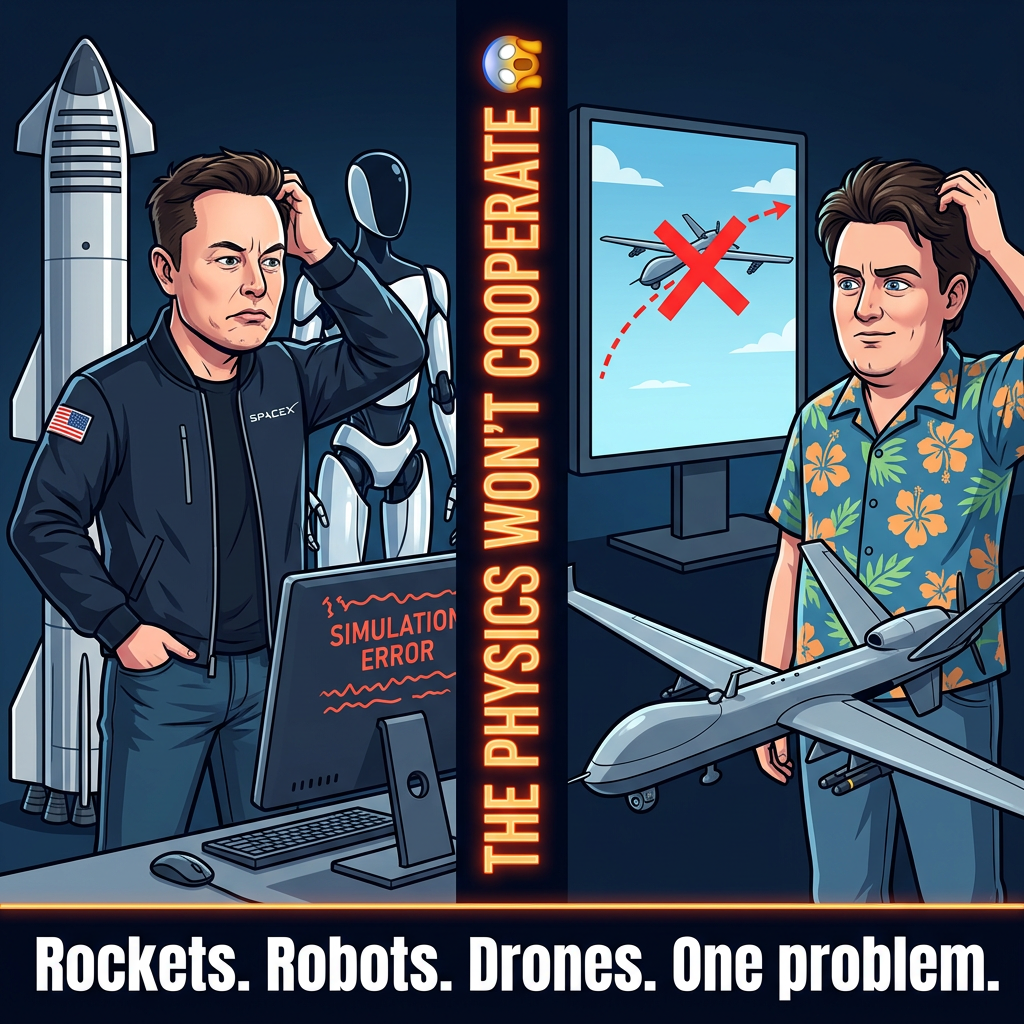
Two of the greatest builders of our generation are running into the same invisible wall.
Elon Musk is landing rockets autonomously, shipping humanoid robots at scale, tunneling under major cities, and wiring human brains to computers. The portfolio of ambition is genuinely unmatched in modern history.
Palmer Luckey just closed a $20 billion Army contract ceiling, raised $4 billion at a $60 billion valuation, and built Anduril Industries into the defense tech company that makes the old guard look slow. His Lattice OS platform is becoming the operating system of modern autonomous warfare.
Both men deserve enormous credit. And both of them — along with every engineer on their teams — are fighting the same problem every single day.
The Invisible Bottleneck
It doesn't show up in press releases. It's the gap between what the simulation predicts and what happens in the real world.
A Starship reentry that performs perfectly in simulation — then surprises the team at 40,000 feet. A Tesla Optimus hand that works flawlessly in the lab — then drifts on the factory floor. An Anduril Lattice-guided drone that hits in every simulation run — and misses by 15 meters in the field.
The problem is not the AI. Not the hardware. It's the physics engine underneath — and the numerical energy drift that compounds quietly with every simulation timestep.
Why This Happens
Every physics simulation runs on a numerical integrator. At each discrete timestep, a tiny error accumulates. Over millions of steps, it compounds. The simulation diverges from physical reality — quietly, consistently, at scale. Engineers trust simulations that are systematically wrong.
SpaceX: The Reentry Problem
Starship reentry involves a plasma sheath at hypersonic speeds — creating electromagnetic interference, thermal loads, and aerodynamic forces extraordinarily difficult to simulate accurately. Relativistic particle dynamics, plasma PIC simulation, CFD. These are precisely where numerical drift compounds fastest. More accurate simulation means tighter landing envelopes and fewer anomalies between test flights.
Tesla Optimus: The Sim-to-Real Gap
Tesla Optimus has 50+ actuators per hand. Full-body motion planning is a 200-dimensional coupled Hamiltonian dynamical system. The sim-to-real gap is the single biggest barrier between lab performance and factory-floor reliability. Fix the physics at the integrator level — the robot that works in testing works on the production line.
Anduril Lattice: Drone Accuracy
Every autonomous decision Lattice OS makes is based on a simulation prediction. Accuracy of that physics stack determines whether the drone hits or misses. Anduril already validated this thesis when it acquired Aechelon Technology — a physics-based simulation company — on March 26, 2026.
The Same Problem. The Same Fix.
Rockets. Robots. Drones. Tunnels. Neural interfaces. Every platform runs on simulation. Every simulation runs on a physics integrator. Every integrator accumulates numerical drift. The fix is a correction at the integrator level — engine-direct — that eliminates energy drift before it compounds. That solution exists. Validated across five simulation domains. Not projections. Benchmarks. The simulation accuracy problem is the last unsolved bottleneck in physical AI. And it's solved.
What's the most underrated engineering problem in your field? Drop it in the comments.
— Jimmy Hayes, Founder & CMO, Data Power Supply (datapowersupply.com)

Comments