
Most of the World Has Never Touched AI. That Sounds Crazy to Me.
By Rich Washburn, CIO — Data Power Supply
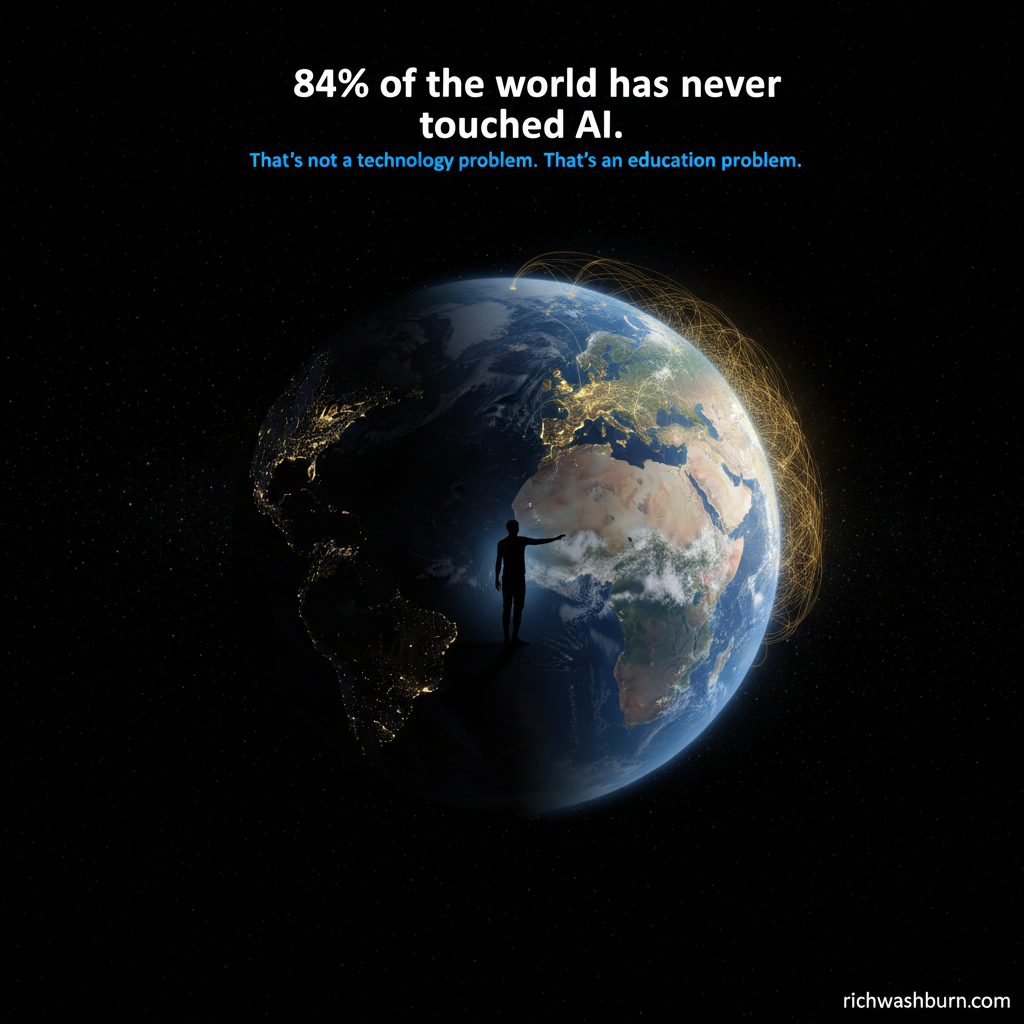
Somewhere around 84% of the world's population has never used an AI tool. Not once.
I want you to sit with that for a second.
We have access to something that can think alongside us. Something that helps us navigate the most complicated moments of our lives — smarter, faster, more capable than we've ever been on our own. And most people have just... not tried it.
I don't say that to judge anyone. I say it because I find it fascinating and a little heartbreaking at the same time.
The Literacy Gap Nobody's Talking About
Every major technological transition in history has had two phases: the invention, and the education.
Steam power didn't transform civilization the moment James Watt built the engine. It transformed civilization when enough people understood it, applied it, and built institutions around it. Electricity didn't change daily life when Edison lit up a bulb. It changed daily life when electricians were trained, buildings were wired, and the power grid became something ordinary people just relied on — without thinking about it.
We are deep in phase one of AI. We are barely in phase two.
The tools exist. The capability is extraordinary. The technology has already crossed the threshold — the people building it will tell you that. But the human infrastructure to receive it, understand it, and use it with any fluency? Almost entirely absent.
And unlike electricity or steam, the gap between those who use this well and those who don't isn't a gap in physical access. It's a gap in understanding. In comfort. In the basic mental models that make any technology feel usable rather than alien. That's a different problem. And it needs a different solution.
Why Fear Is the Wrong Diagnosis
The instinct, when people hear "84% haven't used AI," is to assume the solution is access. Better internet. Cheaper devices. More availability. That's not it.
The people who have access and still won't touch it aren't being held back by infrastructure. They're being held back by something harder to fix: they don't know what it is, they don't know what it's for, and they have a growing pile of scary headlines telling them it's coming for their job, their privacy, their kids, and possibly the future of the species.
Think about the last time you tried to learn something while you were afraid of it. Anxiety collapses curiosity. You don't explore — you brace. You don't ask questions — you look for reasons to confirm your fear and step back.
The fear makes sense. The response to the fear — avoidance — is the problem. Because the less you understand something, the more frightening it becomes. It's a loop. And nobody is building the off-ramp.
What Fluency Actually Means
The moment someone actually understands what AI is and what it isn't, the fear doesn't just shrink. It inverts.
It becomes curiosity. Then engagement. Then something close to wonder.
That shift doesn't require a computer science degree. It requires something much simpler: understanding what this tool can do for you, specifically, in the context of your actual life and your actual work. Knowing how to ask a good question. Knowing when to trust it, when to push back, when to verify. Treating it less like a search engine and more like a thinking partner you brief.
That's a thinking skill. Not a technical one. And thinking skills can be taught.
The Civilization-Level Stakes
Every major expansion of human capability has eventually reached everyone. Literacy. Numeracy. Access to information. Each of these, when new, was concentrated in the hands of a few — and each time, the societies that democratized access fastest built the most durable advantage.
AI is the same transition. Just faster. With higher stakes.
The 11-year-old who grows up AI-fluent will navigate the world with a cognitive advantage that peers who weren't taught simply won't have. The professional who builds fluency now will operate at a level of output and decision quality that compounds over years. The business that integrates this into its culture will look, in five years, like it had a ten-year head start.
That 84% is not destiny. It's a measurement of a moment we are still inside — which means we can still change it.
The Off-Ramp Exists
It's a tool that helps you think. That's it.
It helps you draft the email you've been dreading. It helps you understand the medical report your doctor handed you. It helps you figure out what questions to ask the lawyer before you're sitting across from them billing by the hour. It helps you solve the problem at work that you've been quietly worried about for three weeks.
The fact that 84% of the world is still on the outside looking in isn't a failure of the technology. It's a failure of education. Of communication. Of treating fluency like a luxury when it's rapidly becoming a baseline.
Newton's problem was that he never found the philosopher's stone. Our problem is stranger: we found it, and most of the world doesn't know what to do with it yet.
The technology is not the bottleneck anymore. Understanding is.

Comments